
DEXA Scan in Marbella
A DEXA scan measures bone mineral density and estimates body composition, meaning how much of your body is bone, fat and lean tissue, and where that tissue sits. Both the bone density scan and the body composition scan are available in Marbella. DEXA scanning is not performed at CellOrtho. The scan is carried out by Executive Health, a private diagnostics clinic in Marbella, and the results are reviewed with our medical team in consultation rather than handed over as a report on their own.
What is a DEXA scan?
A DEXA scan, also written DXA, is a dual-energy X-ray absorptiometry scan that passes two low-dose X-ray beams through the body and measures how much of each beam is absorbed by different tissues. Because bone, fat and lean tissue absorb the beams differently, the scanner can separate them and report each one as a measured value.
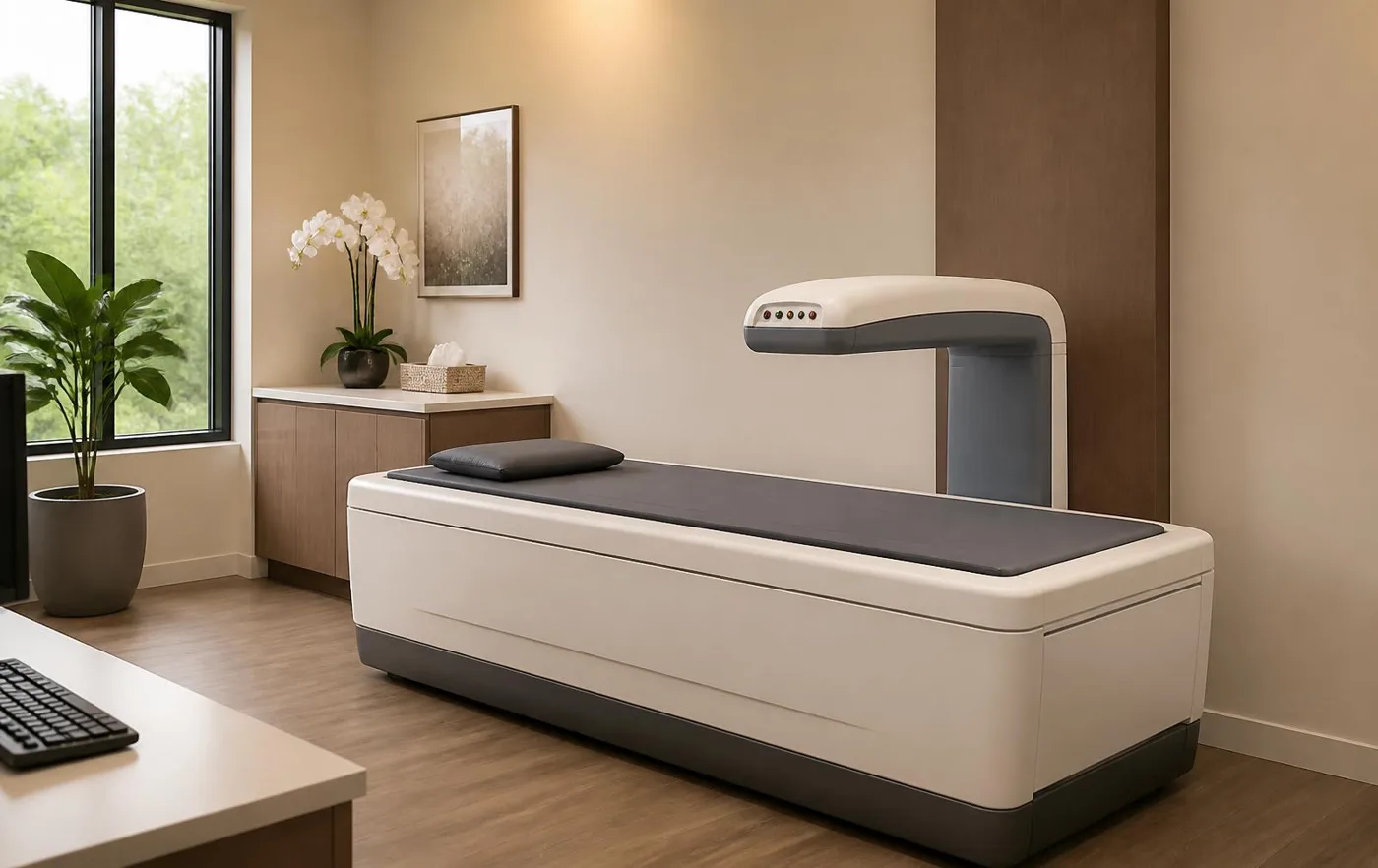
You lie still and fully clothed on a padded table while a scanning arm moves over you. Nothing touches you and nothing is injected. The output is a set of numbers and images that are used to assess bone density or body composition, and those numbers are then reviewed with a doctor.
What does a DEXA scan measure?
A DEXA scan measures bone mineral density, fat mass, lean soft tissue mass, and how these are distributed across regions of the body such as each arm, each leg, and the trunk. A whole body scan also produces an estimate of visceral fat, the fat stored around the abdominal organs.
The measurements are regional as well as total, which is what makes DEXA useful beyond a single body fat percentage. Seeing that lean mass differs between the left and right leg, or that bone density is lower at the hip than the spine, gives information a single whole body figure cannot.
What is the difference between a bone density scan and a body composition scan?
A bone density scan looks at specific skeletal sites, usually the lumbar spine and hip, and reports bone mineral density with T-scores and Z-scores. A body composition scan is a whole body scan that reports fat mass, lean mass and their distribution, along with a visceral fat estimate.
They use the same machine and the same underlying technology, but they answer different questions and are read differently. Which one is appropriate depends on why you are scanning, and that is decided in consultation before the referral is arranged.
What is a T-score and what do the numbers mean?
A T-score compares your bone mineral density with that of a healthy young adult reference population, expressed as the number of standard deviations above or below that reference. A score of 0 sits at the reference average, negative scores sit below it, and positive scores sit above it.
In widely used classifications, a T-score of -1.0 or above is described as normal, between -1.0 and -2.5 as reduced bone density, and -2.5 or below as a level that may indicate osteoporosis. A Z-score compares you instead with people of your own age and sex, which is more relevant for younger patients.
These thresholds are statistical categories rather than a diagnosis on their own. Bone mineral density contributes to fracture-risk assessment. In appropriate patient groups, T-scores can support an osteoporosis diagnosis; results are interpreted alongside age, fracture history and other clinical factors. Results vary between individuals.
Who should consider a bone density scan?
A bone density scan is commonly considered by post-menopausal women, men over roughly 70, anyone who has fractured a bone after a minor fall, people with a family history of osteoporosis, and those on long-term corticosteroid treatment or with conditions known to affect bone.
It is also relevant for patients who are physically active and want a baseline before increasing loading, and for those who are considering or have had orthopaedic intervention where bone quality is part of the picture. Whether a scan is useful for you is a discussion to have with a doctor.
Who should consider a body composition scan?
A body composition scan suits anyone who wants an objective measurement of fat and lean tissue rather than an estimate: people working on a training programme, patients recovering from injury or surgery who want to see whether lean mass is returning, and those tracking change through a weight or metabolic health programme.
It is also used simply as a baseline. A single scan is a snapshot, and its value grows when a later scan is compared against it using the same machine and the same protocol.
How accurate is a DEXA scan compared to other body composition methods?
DEXA is treated as the practical reference standard for body composition in clinical and research settings, and it tends to be more consistent between measurements than bioelectrical impedance scales or skinfold calipers.
No method is exact. Body composition is an estimate derived from the scan measurements rather than an exact determination. DEXA has its own margin of error, and results can shift with hydration, meal timing and differences between machines. The practical rule is to compare scans done on the same scanner under the same conditions, rather than comparing a DEXA figure with a number from a different method.
Why does visceral fat matter more than total body fat?
Visceral fat is the fat stored around the abdominal organs, and it behaves differently from the subcutaneous fat under the skin. It is metabolically active, and higher levels are associated in research with cardiovascular and metabolic risk in a way total body fat alone is not.
Two people can carry the same total fat mass with very different amounts of it stored viscerally. Because DEXA reports a visceral estimate separately, it can show change in that specific compartment even when total weight and total fat have barely moved. This is one measurement among many and is reviewed with a doctor rather than read in isolation.
What happens during a DEXA scan?
You lie on your back on a flat padded table, fully clothed, and stay still while a scanning arm passes slowly above you. It takes around 10 to 15 minutes, nothing touches you, and the process is painless.
Before the scan you remove jewellery, watches and anything metal from your pockets, and confirm there is no possibility of pregnancy. Positioning aids may be used to place your legs or feet correctly. Afterwards you can go straight back to normal activity with no recovery period.
How much radiation does a DEXA scan involve?
A DEXA scan uses ionising radiation at a very low dose, typically a small fraction of the dose of a standard chest X-ray. That is a general comparison rather than a statement that there is no exposure at all, and Executive Health can confirm the dose for the specific scan you are having.
Because there is exposure, scans are performed only where there is a clinical reason and are not performed during pregnancy. The dose, the reason for scanning and any alternatives are discussed with a doctor before a scan is arranged.
How should I prepare for a DEXA scan?
Preparation is minimal. You do not need to fast for a standard bone density scan, and you should wear comfortable clothing without metal zips, hooks, underwiring or buckles over the areas being scanned.
Avoid calcium supplements on the day of the scan, since they can interfere with readings, and leave at least a few days between a DEXA scan and any imaging study that used contrast dye or a radioactive tracer. For body composition scans, keeping hydration and meal timing consistent between scans makes repeat comparisons more reliable. Tell the team about any implants or previous fractures beforehand. Executive Health confirms the preparation instructions that apply to your specific scan.
How often should a DEXA scan be repeated?
For bone density, repeat scanning is usually considered after one to two years, because bone changes slowly and shorter intervals rarely show a change larger than the measurement error.
For body composition, three to six months is a more common interval, since fat and lean mass respond faster to training and nutrition changes. Scanning is not useful for everyone, and a repeat scan is not automatically necessary. Which scan is appropriate, and when it should be repeated, requires individual justification and is decided with a doctor.
Arrange a DEXA Scan in Marbella
Book a free video consultation to discuss whether a bone density or body composition scan would be useful for you. We agree on the right scan, arrange the referral and review the results with you afterwards.
Where the Scan Takes Place
DEXA scanning is carried out at Executive Health, CellOrtho's diagnostic partner in Marbella and the same partner we work with for private MRI scanning. Executive Health is a private diagnostics clinic and is not subject to public waiting lists; they confirm appointment availability.
CellOrtho arranges referrals, agrees with you which scan is appropriate, and reviews the results with you afterwards in consultation. The scan is performed by the Executive Health team at their own facility in Marbella.
Our diagnostic partner
Executive Health Marbella
Private diagnostics clinic in Marbella offering DEXA bone density and body composition scanning alongside MRI and full health screening.
Visit Executive HealthDEXA Compared With Other Body Composition Methods
How DEXA differs from the methods most people have used before.
| Method | What it measures | Accuracy | Distinguishes visceral fat | Measures bone density | Typical use case |
|---|---|---|---|---|---|
| DEXA | Bone mineral density, fat mass, lean mass, regional distribution | Reference standard used in research and clinical practice | Yes, estimates visceral fat separately | Yes | Bone density assessment and detailed body composition tracking |
| Bioelectrical impedance scale | Estimated fat and water percentage from electrical resistance | Variable, affected by hydration, food and time of day | Only as a rough estimate | No | Frequent home tracking of broad trends |
| Skinfold calipers | Subcutaneous fat thickness at set sites | Depends heavily on the skill of the person measuring | No | No | Low cost repeat measurement by a trained practitioner |
| BodPod | Whole body fat and lean mass via air displacement | Good for total fat mass, no regional detail | No | No | Whole body fat percentage in sports science settings |
Scroll the table sideways on smaller screens to see every column.
Bone Density and Joint Health
Bone quality is part of the picture when we assess a painful joint. The bone underneath a joint surface carries load, and reduced density may indicate that the tissue around a knee or hip is responding differently to that load than expected. It is also relevant to fracture risk in patients who remain active into later life.
Bone status can influence whether particular interventions are appropriate and how conservative a rehabilitation plan should be. For patients we see for knee pain, hip pain or back pain, a bone density measurement is one more piece of information used to assess the situation, always reviewed with a doctor.
DEXA for Athletes and Active Patients
For athletes and active patients the interesting output is not a single body fat number but the regional detail. DEXA reports lean mass limb by limb, which makes asymmetry visible: after a knee injury or a period on crutches, one leg often carries measurably less lean tissue than the other, and that gap can be tracked as rehabilitation progresses.
It is also used to follow a training block. Scanning at the start and end of a phase shows whether added weight came from lean tissue or fat, and whether a period of dieting cost muscle. This audience is distinct from the osteoporosis audience, though active patients with a history of stress fractures or low energy availability may want both measurements.
Why Body Composition Beats a Bathroom Scale
A bathroom scale gives one number that combines fat, muscle, bone and water. Because those components change independently, that single number can stay flat while the body underneath changes considerably, or move for reasons that have nothing to do with fat, such as a day of higher salt intake or a change in training volume.
Two people at the same height and the same weight can have very different compositions, one carrying substantially more lean tissue and less fat than the other. Splitting weight into its parts, and showing where that tissue sits, is the difference between guessing at what changed and measuring it.
What to Do With Your Results
Results are reviewed with our medical team in consultation rather than sent to you as a standalone report. A doctor goes through what the figures mean in the context of your age, history, activity level and symptoms, and explains which numbers are worth acting on and which are not.
Where relevant, DEXA results are interpreted alongside blood markers such as vitamin D, calcium and hormone levels, which you can arrange through our blood test in Marbella service, or as part of a health optimisation consultation. The first scan is mainly a baseline: its real value appears when a later scan is compared against it. A scan does not diagnose a condition on its own, and results vary between individuals.
Frequently Asked Questions
Common questions about this treatment
Important Medical Disclaimer
This information is provided for educational purposes only and does not constitute medical advice. A DEXA scan produces measurements that may indicate reduced bone density or a particular body composition pattern, and it does not diagnose any condition on its own. Results are interpreted in consultation with a qualified doctor alongside your history and any other findings, and they vary between individuals. DEXA scanning uses a low dose of ionising radiation and is not performed during pregnancy. Always consult a qualified healthcare professional.
Medically reviewed by Dr. Arvin Yarollahi, Specialist in Orthopaedic Surgery and Traumatology. Last reviewed .
Arrange a DEXA Scan in Marbella
Book a free video consultation to discuss whether a bone density or body composition scan would be useful for you. We arrange the referral and review the results with you afterwards.
Book a Free Video ConsultationAlso see our private MRI scanning and blood testing in Marbella.