Arthrosamid Injection for Knee Osteoarthritis in Marbella
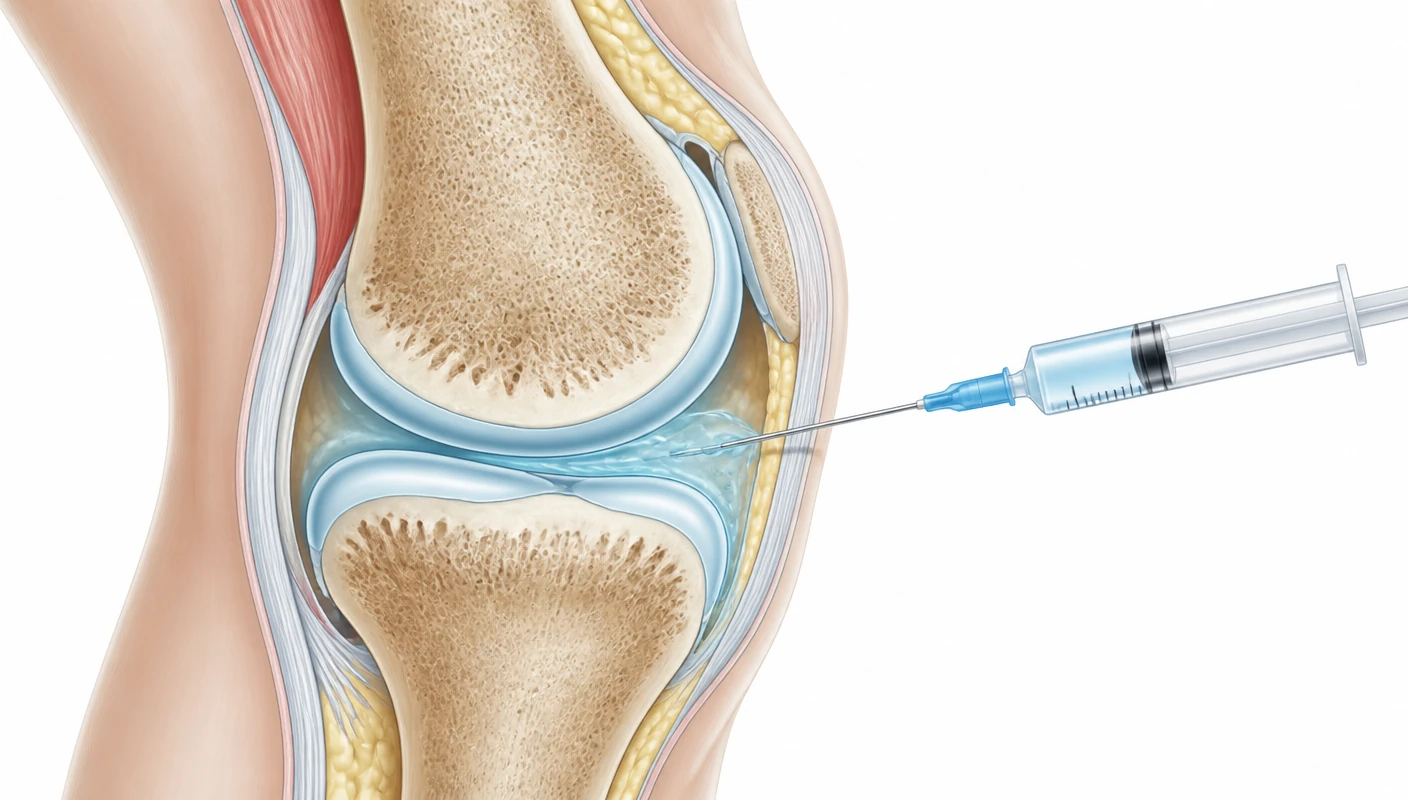
Arthrosamid is an injectable polyacrylamide hydrogel used in the management of symptomatic knee osteoarthritis, given as a single injection into the knee joint and performed at our clinic in Marbella by a licensed orthopaedic specialist. It is not absorbed by the body, it is licensed for the knee only, and suitability is confirmed in a medical consultation before treatment is offered. Results vary between individuals.

What is Arthrosamid?
Arthrosamid is an injectable polyacrylamide hydrogel, often shortened to iPAAG, that is injected into the knee joint in the management of symptomatic knee osteoarthritis. It is composed of 2.5% cross-linked polyacrylamide and 97.5% water, is manufactured by Contura, and is approved in Europe for symptomatic knee osteoarthritis.
It is delivered as a single 6ml intra-articular injection. Unlike medication that is taken over time or treatments that require a course of appointments, the standard treatment is one injection into the affected knee. It is not a drug in the conventional sense and it does not contain a steroid or an anti-inflammatory medicine.
Arthrosamid Spain is increasingly asked about by patients who have already tried physiotherapy, painkillers or other injections, and who want to understand what options exist before considering surgery. It is one option among several, and it is not appropriate for everyone.
How does Arthrosamid work?
On injection, the hydrogel integrates into the synovial tissue of the inner joint capsule, adhering to and augmenting the synovial membrane that lines the knee. Rather than sitting loose in the joint fluid, it becomes incorporated into the tissue at the inner surface of the capsule.
The hydrogel is non-absorbable, non-biodegradable and non-migratory. It is not broken down by the body, it is not metabolised away over time, and it stays where it is placed. This is what gives the treatment its durability compared with injectable products that the body absorbs.
The exact mechanism by which this leads to a reduction in pain is still being studied. Proposed explanations include a cushioning effect at the joint capsule and changes in the synovial lining, but these are not settled, and it would be inaccurate to present any one explanation as established fact. What can be said is what has been reported in clinical studies, which is set out further down this page.
Is Arthrosamid permanent?
The hydrogel itself is permanent in the sense that it does not break down and is not absorbed by the body. Once injected, it remains in the knee. That is a factual property of the material and it should be understood clearly before treatment.
Permanence of the material is not the same as permanence of symptom relief. The duration of any improvement varies between individuals, and studies report a range of outcomes rather than a uniform result. We would not describe this treatment as a permanent answer to knee pain.
The practical consequence is that patient selection matters more here than with an absorbable treatment. If an absorbable injection does not suit you, it clears from the joint. That is not the case with a non-absorbable hydrogel, which is why assessment before treatment is thorough and why the treatment is not offered to everyone who asks for it.
Who is suitable for Arthrosamid?
Arthrosamid is generally considered for adults with symptomatic osteoarthritis of the knee whose pain has not been adequately managed by measures such as physiotherapy, weight management, activity modification or oral pain relief, and who are looking for a non-surgical option.
In practice, the patients most often assessed as suitable are those with a confirmed diagnosis of knee osteoarthritis supported by recent imaging, ongoing pain that affects daily activity, and no active infection in or around the joint. Some patients considering it are trying to reduce or delay the need for surgery; others are not candidates for surgery at present.
Suitability is confirmed individually in consultation, taking account of the state of the joint, your medical history and what you are trying to achieve. A free video consultation is the starting point, and it carries no obligation to proceed.
Who is not suitable for Arthrosamid?
Arthrosamid is not appropriate for anyone with an active infection in or near the knee, an infection elsewhere in the body that could seed the joint, or a known sensitivity to any component of the product. In these situations it should not be given.
It is also not used where the problem is not knee osteoarthritis. Pain arising from another joint, from the spine, from a tendon or from an inflammatory arthritis is a different clinical picture and calls for a different approach. It is licensed for the knee only, so hip, shoulder and other joints are outside its use.
Beyond the absolute contraindications, there are cases where the joint is advanced enough, or the clinical situation uncertain enough, that a non-absorbable implant is not the sensible next step. Pregnancy, planned imminent knee surgery and certain immune conditions are all factors that are reviewed. If we do not think it is right for you, we will say so.
How does Arthrosamid compare to hyaluronic acid injections?
The main difference is that hyaluronic acid is absorbed by the body and Arthrosamid is not, which is why hyaluronic acid is typically repeated periodically while Arthrosamid is given as a single injection. Hyaluronic acid is used as a viscosupplement, intended to supplement the joint's own synovial fluid, and its effect diminishes as the product clears.
A randomised comparison of Arthrosamid against hyaluronic acid was published in 2024, and a systematic review has summarised the wider evidence base. These are described in the research section below rather than reduced to a single claim here.
The trade-off is straightforward. A repeatable absorbable product carries less commitment; a non-absorbable one avoids repeat injections but cannot be withdrawn. Which trade-off suits you is a discussion to have with a doctor.
How does Arthrosamid compare to corticosteroid injections?
Corticosteroid injections act as an anti-inflammatory medication and are generally used for short-term management of a painful flare, whereas Arthrosamid is a non-medicated hydrogel given once and intended for longer-term management. They are used for different purposes rather than being direct substitutes.
Because corticosteroid is a medicine, the number of injections into a joint is usually limited, and repeated use is approached cautiously. Arthrosamid does not contain a steroid, so the considerations are different, but the non-absorbable nature of the hydrogel brings its own considerations, particularly around infection.
In some patients a corticosteroid injection is still the more appropriate step, for example where a short-term flare needs settling. That is a clinical judgement, not a ranking.
What is the difference between Arthrosamid and PRP?
PRP uses the patient's own blood and is typically given as a course of three sessions, while Arthrosamid is a single injection of a synthetic hydrogel that is licensed for the knee only. That is the core difference: autologous and repeated versus synthetic and once.
PRP therapy is prepared by drawing a small blood sample, concentrating the platelets in a centrifuge and injecting the preparation into the affected area. Nothing synthetic is introduced, and it is not limited to the knee, so it is also used for the shoulder, hip, elbow and tendon problems. Because it is absorbed, it can be repeated.
Arthrosamid is a manufactured hydrogel that stays in the knee. There is no blood draw and no course of appointments. It is a single visit for the injection, then follow-up.
These suit different patients, and the choice between them is made in consultation rather than on price. Some patients are better served by an autologous option they can repeat; others by a single injection they do not need to return for. If you are unsure which category you fall into, that is exactly what the consultation is for.
Arthrosamid, PRP, hyaluronic acid and corticosteroid compared
| Treatment | What it is | Number of injections | How long effects have been reported to last | Joints treated | Typical use case |
|---|---|---|---|---|---|
| Arthrosamid | Injectable polyacrylamide hydrogel (iPAAG), 2.5% cross-linked polyacrylamide and 97.5% water | Single 6ml injection | Effects have been reported in studies at up to five years, with ten-year safety follow-up presented | Knee only | Symptomatic knee osteoarthritis where other measures have not given enough relief |
| PRP | Platelet-rich plasma prepared from the patient's own blood | Typically a course of three sessions | Studies commonly report benefit over months, with repeat courses used | Knee, hip, shoulder, elbow, tendons and other sites | Joint and soft tissue conditions where an autologous, non-synthetic option is preferred |
| Hyaluronic acid | Absorbable gel intended to supplement the joint's own synovial fluid | One injection or a course, depending on the product | Reported benefit generally measured in months before repeat injection is considered | Mainly knee, some other joints | Viscosupplementation in osteoarthritis, repeated periodically |
| Corticosteroid | Anti-inflammatory steroid medication | Single injection, repeated at limited intervals | Reported relief typically short term, often weeks to a few months | Most joints | Short-term management of an inflammatory flare |
This table summarises how these treatments differ in approach. It is not a ranking, and it does not predict how any individual will respond. Results vary between individuals.
Can I still have a knee replacement after Arthrosamid?
Having had Arthrosamid does not in itself rule out a future knee replacement. Ten-year follow-up data reported surgical records from subsequent knee replacements showing no indications of unusual adverse reactions in the patients concerned.
That is a factual account of what was reported in follow-up, not a guarantee about any individual case. Suitability for future surgery is assessed individually by the surgeon at the time, taking account of the joint, your general health and the operation planned.
It is sensible to tell any surgeon or radiologist that you have had a non-absorbable intra-articular hydrogel injected into the knee, so that imaging is interpreted correctly and the operative plan accounts for it.
What happens during an Arthrosamid appointment?
The appointment itself usually takes around 30 minutes and consists of a check of the knee, cleaning and local anaesthetic, then a single 6ml injection into the joint, followed by a short period of observation before you go home.
Before that appointment there is a free video consultation, a review of your history and recent imaging of the knee, and confirmation that treatment is appropriate. If you do not have a recent X-ray or MRI, we can arrange one locally. See MRI in Marbella for how that is organised.
On the day, arrange for someone else to drive you home. Plan to rest the knee for the first few days. You will be given written aftercare guidance and a point of contact, and a follow-up is arranged so your response can be reviewed.
How long does it take to work?
Studies report that any improvement develops over weeks rather than immediately, most often described within the first one to three months after injection. It is not a treatment that is expected to change how the knee feels the same afternoon.
Some patients notice a change earlier than that and some later. Recent research has identified that a proportion of patients do not respond at all, which is an important part of the picture and is covered in the research section below.
Because of this timeframe, follow-up is normally scheduled some weeks after treatment rather than in the first days, so there is something meaningful to assess.
How long do the effects last?
Five-year prospective efficacy results have been presented for Arthrosamid, and ten-year safety follow-up data have also been reported, which is why it is described as a durable option rather than a short-term one. What is reported in studies is not a promise about an individual outcome.
The hydrogel remaining in the joint indefinitely does not mean symptom relief lasts indefinitely. Knee osteoarthritis is a progressive condition, and the joint continues to change over time regardless of what has been injected into it.
Duration is discussed honestly in consultation, in the context of your own knee rather than in the abstract. Results vary between individuals.
What are the risks of Arthrosamid?
The most commonly reported effects after injection are local: pain, swelling, stiffness or warmth around the knee in the days that follow, which usually settle. As with any injection into a joint, there is also a risk of bleeding, of a reaction to the local anaesthetic, and of infection.
Infection deserves particular attention here. Infection in a joint that contains a non-absorbable implant is a more serious complication than infection after a treatment that is absorbed, because the material cannot simply be cleared by the body and management may be more involved. This is a real consideration, not a formality, and it is one of the reasons active infection anywhere in the body must be excluded before treatment.
Because the hydrogel is not absorbed, it cannot be withdrawn if you are unhappy with the result. There is also the possibility of no meaningful improvement. We do not describe this treatment as completely safe or risk free, and any clinic that does is overstating the position. All risks are explained in full before you consent.
What does the research show?
The evidence base for Arthrosamid is growing but is still limited in quality, and it should be read with that in mind.
- A systematic review of five studies covering 463 patients reported reductions in mean WOMAC scores, with statistically significant results in two of the studies at 52 weeks and at 13 months.
- Five-year prospective efficacy results have been presented, alongside ten-year safety follow-up data, with few adverse events reported over that period.
- A randomised comparison of Arthrosamid against hyaluronic acid was published in 2024.
The limitations matter as much as the findings. Much of the evidence base consists of open-label case series rather than blinded randomised trials, which makes it harder to separate the effect of the treatment from the effect of expectation and of natural fluctuation in osteoarthritis symptoms. Study populations have generally been modest in size.
Recent research has also identified that a proportion of patients do not respond to the treatment. That is a meaningful finding for anyone considering an injection that cannot be reversed, and we would rather you weigh it before treatment than discover it afterwards.
What can fairly be said is that Arthrosamid is supported by clinical evidence for use in the management of symptomatic knee osteoarthritis, that reported outcomes vary, and that the strongest forms of evidence are still accumulating. We describe what studies reported, attributed to those studies, rather than presenting numbers as outcomes you should expect.
How much does Arthrosamid cost in Marbella?
Arthrosamid at CellOrtho in Marbella costs €3,000 per treated knee, which covers the injection appointment, the product itself and the clinical assessment on the day. The video consultation beforehand is free.
If both knees are being treated, they are normally treated on separate occasions and priced per knee. Any imaging you need arranged, such as an X-ray or MRI, is quoted separately, and we will tell you the cost before anything is booked.
You can compare this with our other options on the prices page. Cost should not be the deciding factor between a treatment that is absorbed and one that is not, and we would encourage you to make that decision clinically rather than on price.
Can I travel to Spain for Arthrosamid treatment?
Yes. Arthrosamid is practical for patients travelling from the UK, Scandinavia or elsewhere in Europe because it is a single injection with no need to return for repeat sessions, so the whole treatment fits into one trip.
A typical visit works like this. The free video consultation happens before you travel, and we review your imaging remotely so that suitability is largely established in advance. Once here, you attend the clinic for assessment and the injection, which is normally the same visit and takes around 30 minutes. Most patients plan to be in Marbella for two to three days, allowing a day either side of the injection to rest the knee before flying.
Follow-up is done by video, so you do not need to return to Spain for it. If you need imaging arranged locally before treatment, that can usually be scheduled around your arrival. We treat patients from across the Costa del Sol and from further afield, and our clinic page explains where treatment takes place.
Related pages
If you are researching options for the knee, these pages cover the surrounding ground:
- Knee pain and knee osteoarthritis Causes, assessment and the non-surgical options we offer.
- PRP therapy An autologous alternative, given as a course and not limited to the knee.
- All treatments The full range of non-surgical treatments at CellOrtho.
- MRI in Marbella Imaging arranged locally where a recent scan is needed.
- Health optimisation Wider factors that affect joint loading and recovery.
Frequently Asked Questions
Common questions about this treatment
Important Medical Disclaimer
This information is provided for educational purposes only and does not constitute medical advice. Treatment outcomes, suitability, and recovery timelines vary between individuals. This therapy is not intended to diagnose, treat, cure, or prevent any disease, nor to replace appropriate medical care or surgical consultation where indicated. Always consult a qualified healthcare professional.
Medically reviewed by Dr. Arvin Yarollahi, Orthopaedic and Sports Medicine Specialist. Last reviewed .
Discuss whether Arthrosamid may be appropriate for you
Speak with our medical team before committing to travel or treatment. There is no obligation to proceed.
Book a Free Video Consultation